


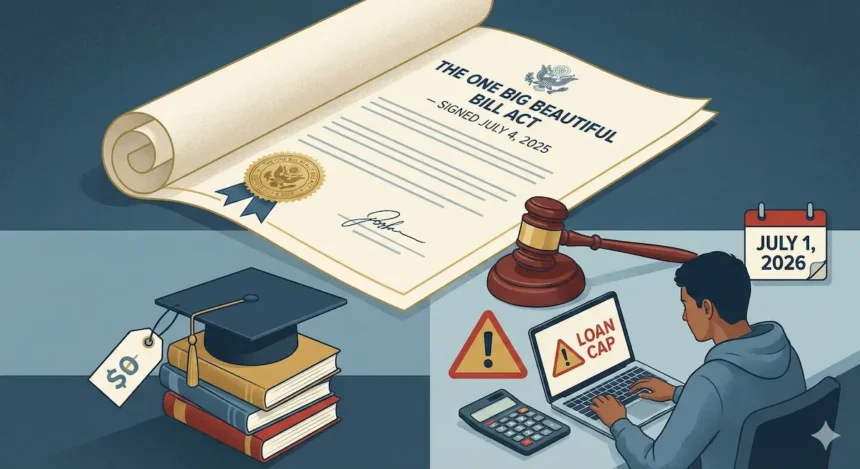
Jon Stewart’s remarks on “The Daily Show” regarding Trump’s “One Big Beautiful Bill Act” highlight the big picture and what Americans might expect in the long run.
If you’ve been doom-scrolling through TikTok and Reddit lately to find answers about these upcoming student loan changes and how they will affect your education, you are actually making the right move.
There’s panic and fear; people are whispering about the Big Beautiful Bill Act and wondering if they will lose their health insurance, end Biden era green energy credit, and lose access to medical aid support.
“The problem in our country isn’t the sliver of able-bodied people that are somehow coasting on the unearned medical coverage they may or may not use, but the millions and millions of people in this country who work fucking full-time jobs and still need food and medical assistance! That’s the system that’s broken! Fix that system!”
At ScholarJoiner, we care about the facts, we will explain the One Big Beautiful bill, new changes, and how it will affect common American citizens.
The United States President Donald Trump and the Congress explicitly passed this new bill into law on the fourth of July 2025.
Major Changes:
1. The End of Unlimited Grad PLUS Loans
“This bill is the most fucked-up performance review our country could ever deliver.”
This is the headline that has everyone stressed, and for good reason. For years, graduate students could borrow “Grad PLUS” loans up to the full cost of their university attendance. If tuition and living expenses were $80,000 a year, you could borrow $80,000.
What is there for new borrowers? Starting from July 1, 2026, the option is gone. And that’s reality.
Key Highlights
- The “One Big Beautiful Bill Act” (OBBBA), or H.R. 1, was signed into law on July 4, 2025.
- Grad PLUS loans are eliminated for new students.
- You will now be limited to Federal Direct Unsubsidized Loans.
- Most graduate students can only borrow $20,500 per year (with a $100,000 lifetime limit).
- For Professional Students (Med/Law): You will get a higher cap of $50,000 per year ($200,000 lifetime limit).
However, if your Master’s program costs $60,000 a year and the government only gives you $20,500, you are left with a massive “funding gap.”
This is where you must look at private student loans or aggressive scholarship joining strategies to fill the void.
Scholarjoiner Tip: If you are already enrolled and borrowed a Grad PLUS loan before July 1, 2026, you are likely “grandfathered” in for 3 years. But check with your financial aid office immediately.
2. Parent PLUS Loans Are Getting Capped
The transition of Donald Trump’s new act is about to end Biden’s loan era.
For decades, parents could borrow any amount to cover their child’s tuition. The “One Big Beautiful Bill Act” (OBBBA) has actually put a hard stop to that. As a parent how do you feel about this new law? Drop your comment.
The Parents PLUS loans will be capped starting from July 2026. The month of July is fast approaching, what are your best alternatives?
The reality ✔️. Parents will borrow $20,000 per year per student and a $65,000 lifetime limit per student.
In addition, if you are attending a private university where tuition is $60,000/year, the truth is that your parents can no longer just “sign on the dotted line” for the whole amount.
Parents or sponsors will now need to mix federal loans, savings, and private lending to make the math work. That’s among the best alternatives right now.
As caring parents, prepare yourself to meet the new changes because they’re coming soon. “So even though some of our nation’s most vulnerable are taking a pay cut, fear not,” this is from Jon Stewart. Do not panic or fear.
3. The “RAP” Plan vs. The SAVE Plan
What are your plans? Are you searching for Trump student loans or wondering if the Biden-era SAVE is dead?
The truth is that most Americans are really confused right now while major changes are happening soon.
Here is the deal: The SAVE plan (and PAYE) is being phased out. By July 1, 2028, almost everyone will be moved to the new Repayment Assistance Plan (RAP).
What to expect soon (How RAP works)
There are no complicated formulas here. It’s simple. You will pay 1% to 10% of your income, depending on how much you earn.For those who earn very little, you might pay as little as $10/month.
However, the good news is that the RAP plan is designed to stop your balance from growing out of control, that’s (no negative amortization).
And the bad news is that for low earners, the monthly payments under RAP might be slightly higher than they were under SAVE.
4. Who is “CRI” and Why Do They Have My Loans?
CRI (Central Research Incorporated) is an official federal student loan servicer working on behalf of the U.S. Department of Education to manage, process payments, and assist with repayment for federal loans.
They act as a customer service provider for federal student loans, helping borrowers navigate repayment, deferment, forbearance, and consolidation.
If you tried to log into StudentAid.gov recently and got redirected to CRI, you aren’t alone.
Central Research Inc. (CRI) is the new federal loan servicer taking over millions of accounts. They are replacing older servicers to “balance the load,” but the transition has been rocky.
Users are currently reporting on login glitches, trouble setting up auto-pay, and confusion over “grace periods” disappearing. If you see CRI student loans on your bank statement, do not fear or panic. It’s normal and legitimate.
Your next plan however is to set up a new online account immediately to avoid missing a payment by accident. Stay tuned while we work on a full CRI Review on how to help you understand their dashboard.
What Should You Do Now?
The reality is that things are changing very fast soon but you have the power to act early.
If you are starting school this fall you need to check your date because these caps might apply to you. Every student or sponsor needs to fill the gap.
With Federal loans capped, you need a contingency plan. Compare rates for Private Student Loans (like College Ave or Sallie Mae) now, before the summer rush.
Do you need help finding funding that isn’t a loan? Stop relying on debt. Search our database of Scholarships that help you achieve your dream school.
Conclusion
Look, the truth is that reading about “caps” and “limits” is stressful. But the era of unlimited borrowing is officially closing on July 1, 2026, and that changes the math for almost everyone. You’re not alone.
You still have options, always remember that. The “Big Beautiful Bill” might make federal loans harder to get, but it doesn’t close the door on your degree. You have to be smarter about how you pay for it.
Don’t wait until the summer panic sets in. Start looking at private lenders now, and more importantly, get aggressive about finding scholarships.
Finally, your education is an investment not just a debt sentence. Scholarjoiner is here to help you join the right school without the financial heartbreak.
Frequently Asked Questions
What is the Big Beautiful Bill for student loans? +
The Big Beautiful Bill (One Big Beautiful Bill Act) is a new law signed by President Trump. Starting July 1, 2026, it places strict caps on how much money graduate students and parents can borrow from the federal government. It replaces the old “unlimited” borrowing with specific yearly limits.
Is CRI student loans a real company? +
Yes. If you see CRI student loans on your bank statement or email, it is legitimate. Central Research Inc. (CRI) is a new federal loan servicer hired by the Department of Education to manage accounts. You should log in to their official site immediately to set up your payments.
Did the SAVE plan get cancelled in 2026? +
Not exactly, but it is changing. The SAVE plan is being phased out and replaced by the new Repayment Assistance Plan (RAP). Under RAP, your monthly payments are based on 1-10% of your income, but the rules for loan forgiveness are stricter than they were under President Biden.
How do the new Trump student loan rules affect parents? +
The biggest change is for Parent PLUS loans. Starting in July 2026, parents can only borrow up to $20,000 per year for their child’s education. If tuition costs more than that, families will need to use savings, scholarships, or private student loans to pay the difference.
Can I still get loan forgiveness with the new bill? +
Yes, Public Service Loan Forgiveness (PSLF) still exists. However, the new bill removes some of the “loopholes” that allowed for faster forgiveness. You must make 10 years of qualifying payments while working for a government or non-profit employer to get your student loans wiped out.
📚 Read Next: Survive the Funding Gap
-
Best Student Loan Refinance for $100k+ Debt ➤
With federal caps dropping to $20k, high-balance borrowers need a new plan. See the best rates for massive debt loads.
-
7 High-Yield Online Business Models for Students ➤
Don’t just borrow—earn. How to build a cash-flowing side hustle while you study to avoid taking out private loans.
-
Top Universities in Canada (Cheaper Than the USA) ➤
Is the US system too broken? Discover world-class Canadian schools where tuition is a fraction of the cost.